
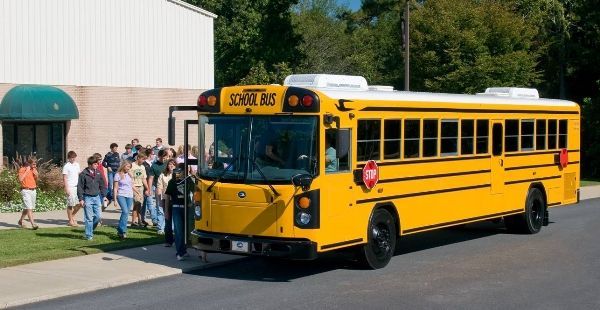
With school transportation costs growing and school budgets seemingly shrinking more and more, school districts across the nation are attempting to find creative solutions to offset costs. While some schools are seeking and using grants to gain alternative fuel buses which cost less to operate and maintain, others are forced to make hard choices.
Some schools have resorted to reducing the number of bus routes, extending time on the buses for students, and in some cases attempting to cut busing entirely. Franklin Township in Indiana didn’t want to limit the amount of transportation available. Unfortunately, voters declined tax-raising referendums to increase revenues for schools which placed transportation on the chopping block.
Their solution was to discontinue school bus service in favor of contracting with a private firm to transport students funded through charging parents a fee for the service.
According to School Bus Fleet, the fee was $450 per child per year for the first student. Each additional child was $405, plus a $20 fee per child. A family with three children would be hit with $1,320 a year for school transportation for their children.
Unsurprisingly, many parents were outraged by the idea and a class action lawsuit was filed against the district. In early June,the Indiana Court of Appeals ruled that the township violated the state constitution by discontinuing bus service.
The court decided as a premise for the ruling that transportation is part of the public education system (emphasis added). It cited state requirements that schools must provide bus service for homeless, foster care, special-needs and even some private school students.
“It is hard to imagine that the legislature meant to require our school corporations to transport these students but exclude all others,” the court said.
The ruling was based on Indiana state law, so it is theoretically possible that actions similar to those taken by Franklin Township may be legal in other states. However I would expect any analogous plan to be met with strong resistance from parents.
It is troubling to see school districts go to these lengths in an attempt to keep transportation affordable. While keeping buses up to regulation and fuel provides a high cost for school districts, there are many common sense measures that can be taken to limit costs such as reducing idling times or adding restored buses to your fleet.
